


Appendix /
Upstream Interlock (Wake Up)
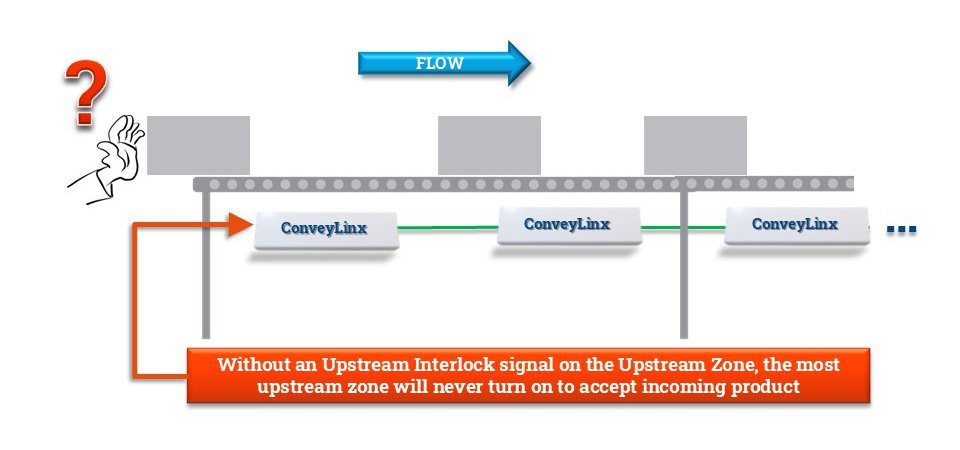
Interlock with the most upstream zone to get an input to see if is clear and then turn on an output (Wake Up) to tell it to run to accept a new item
Whichever side (Left or Right) is on the Upstream Side of the module will accept a Wake Up signal input on its interlock input, Interlock Pin. If the zone is unoccupied, when a digital signal is applied to the Interlock Pin, the zone will run its motor to accept an item.
- When NOT to use the Interlock Pin as a Wake Up
Only use the Interlock Pin signal for Wake Up on the most upstream zone of a network. Do not use the Interlock Pin signal on any of the other zones on modules with an upstream connection to another ConveyLinx module – You may get unexpected results because signal may or may not over-ride the status coming from upstream over the network.
![]()

- Wake Up Interlock with Handshake
-
The external controls providing the Wake Up signal to the Interlock Pin will sometimes also require an output signal from the ConveyLinx module that will indicate when this upstream zone is occupied in order to implement a handshake.
![]()

Post your comment on this topic.