


Carbon Offsets
Scope of Carbon Offset
Project teams are to assess embodied carbon impacts in the context of all opportunities available, including material reduction and reuse strategies. Carbon offsetting does not reduce upfront carbon and is considered a last resort, only after all other measures to avoid or reduce emissions have been exhausted.
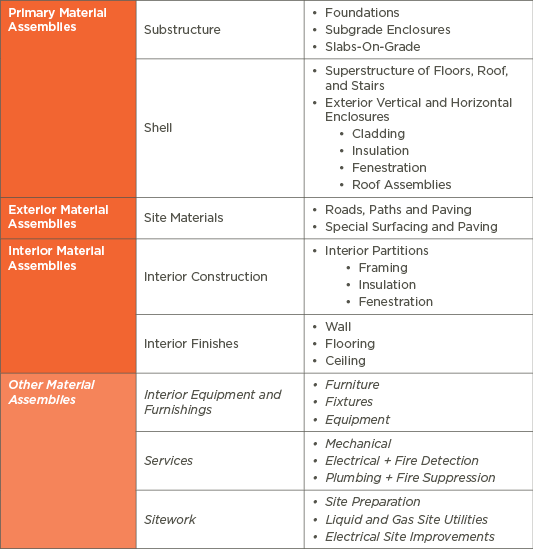
Approved carbon offsets must be procured to cover the total embodied carbon of the project, including impacts from construction and from new or refurbished materials. When calculating the project’s embodied carbon, project teams must include the upfront embodied carbon of their primary material assemblies, interior material assemblies, and exterior material assemblies as shown in Table 8-1. The embodied carbon values may be calculated individually or exported as a subset from the project’s LCA calculations.
If a project uses carbon-sequestering materials, the benefit of those materials can be included in the total embodied carbon quantity calculations. Projects with calculations that prove a net carbon-neutral or carbon-sequestering value based on their materials are not required to procure additional carbon offsets.
Approved Carbon Offsets
Carbon offsets must be certified by Green-e Climate or an equivalent program that ensures additionality, leakage prevention, permanence, and audited verification. Only Certified Emission Reduction (CER) and Verified Emission Reduction (VER) carbon credits are suitable for purchase; renewable energy certificates (RECs) are not acceptable alternatives for carbon offsets.
Green-e certified carbon offsets must meet Gold Standard, Verified Carbon Standard, or Climate Action Reserve requirements for third-party verification. Green-e approved projects can be found here. Other certification programs or verification standards must be submitted as a Request for Ruling for preapproval.
The types of CER and VER carbon offsets allowed are:
- Renewable energy projects. Note that offsets must be from projects that meet the ILFI definition of Renewable Energy, which may be more narrow than definitions used by Green-e Climate or comparable programs.
- Landfill gas-to-energy projects where the methane would otherwise be released to the atmosphere.
- Reforestation projects.
Carbon offsets may be sourced from any location in the world; consideration of local or community-based solutions is encouraged but not required. Consideration of carbon offsets with additional ecological, cultural, human health, or equity benefits is also encouraged but not required.
Large-scale carbon sequestration assets and activities associated with the project owner must be audited through an approved third-party certifier in order to be claimed as a qualifying carbon offset. Project teams looking to pursue this pathway must submit a Request for Ruling for preapproval.
Prohibited Carbon Offsets
The carbon-reducing function of on-site elements, such as native landscapes, may not be applied to the project as a carbon offset or otherwise accounted for in calculating the embodied carbon footprint of the project.
Although reforestation projects are allowed as offsets, forest management strategies, even those that have been shown to increase carbon capture, are not allowed as ILFI-approved offsets because they do not ensure an increase in the amount of forested area or result in additionality.
Applicable Building Materials
For the purposes of assessing the total embodied carbon that must be offset, all permanently installed materials that represent the majority of material quantities and costs associated with the project must be included as shown in Table 8-1. The embodied carbon of all temporary materials, building systems, interior furnishings, equipment, and site work must be reported but does not need to be offset.
Materials that account for the largest quantities within each assembly should be prioritized for reduction, with a focus on achieving the most impactful reductions. Emphasis should be placed on reducing the embodied carbon in the bulk materials listed in Table 8-1.
Calculations do not need to include materials that would create an undue burden to calculate, such as small and miscellaneous materials for which embodied carbon data are not readily available. This includes materials such as adhesives, fasteners, wet-applied coatings, and hardware. Project teams should use their best judgment and include materials that are representative of the carbon impact of the assembly.
See the Resources section for documents that provide guidance on handling detailed subassemblies, specifically RICS Whole Life Carbon Assessment for the Built Environment.
Table 8-1 Applicable Building Materials
Building or Material Reuse, Offsets
Project teams that reuse or repurpose existing structures are not required to claim the original emissions associated with any in-situ materials in the project’s embodied carbon calculations or to purchase carbon offsets for these materials. However, project teams must claim and offset all embodied carbon associated with the refurbishment, transport, and installation (life cycle stages A3–A5) of the salvaged or reused materials. Any new materials added to the reused buildings must be claimed and offset.